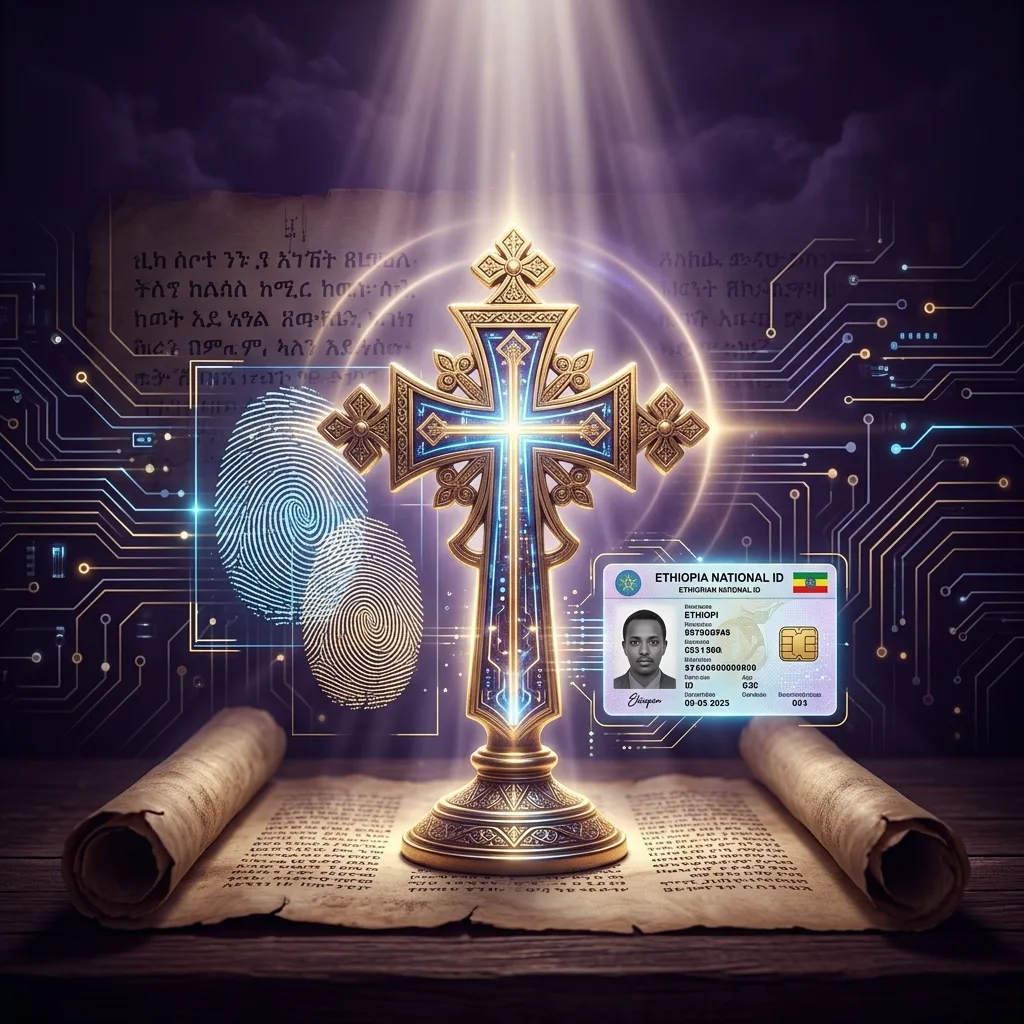
Fayda is Ethiopia's digital ID system, not proven to be the biblical mark of 666. The real questions are privacy, trust, transparency, and how powerful digital systems should be governed.
Direct answer
My view is straightforward there is no public evidence that Fayda is the biblical mark of the beast. Fayda is Ethiopia’s digital identification system.
That does not mean Ethiopians should stop asking questions. It is reasonable to ask how personal data is protected, why banks and service providers need the National ID, how errors are corrected and what happens when access to everyday services depends on one system.
The right response is neither mockery nor panic. We should separate what the Bible says, what the technology actually does and what remains speculation.
Author’s Note
I am writing this as an Ethiopian software professional, not as a pastor or a government spokesperson. I understand why digital identity can be useful, and I also understand why people become uneasy when identity, banking and access to services begin to connect. My goal is to separate the technical facts from the religious claims, then leave readers with better questions to ask.
In this article
- What Does the 666 Sign Mean in Ethiopia?
- What is Fayda?
- Why are people connecting Fayda with 666?
- Is Fayda a religious mark?
- How digital ID technology works
- Privacy and data protection questions
- What Ethiopian citizens should verify
- How secure digital systems should be built
What Does the 666 Sign Mean in Ethiopia?
Most people searching for the “666 sign in Ethiopia” are not asking about an official Ethiopian symbol. They are asking whether the number 666, when it appears in an National ID, payment system or government program, should be understood as the mark described in Revelation 13.
In Ethiopia’s current debate, “666” has become shorthand for a deeper fear; that identity, money and access to essential services could eventually be tied together in a system that ordinary people cannot question or refuse.
That concern is understandable, but resemblance is not proof. Revelation 13 is not simply about finding the digits 6-6-6 somewhere. The passage connects the mark with allegiance, worship and economic pressure. A digital system can raise serious questions about power and coercion without automatically becoming the prophecy itself.
The more useful question is not, “Can I find 666 in this system?” It is, “What does this system require from people, who controls it and what happens to someone who cannot or will not use it?”
In Ethiopia today, conversations about technology are no longer only about convenience
They are becoming conversations about identity, trust, freedom, and even faith. As the country expands its digital systems and national identification infrastructure through Fayda, some citizens see progress, efficiency, and modernization. Others see warning signs. Among Christians especially, one question has emerged with unusual emotional force: Is Fayda somehow connected to the "mark of the beast," the number 666, or an end-times system described in the Bible?
This is not a small question. It is not merely a rumor to dismiss with a laugh. It comes from a real place in people's hearts. Many believers have watched the world become more digitized, more monitored, and more centralized. They see payments becoming digital, services moving online, identities linked to databases, and governments around the world building more integrated systems. For some, this raises a spiritual alarm. They wonder whether the architecture of modern technology is preparing the world for something the Bible warned about long ago.
That concern deserves a serious answer.
The issue is not only theological. It is also psychological, social, and technological. People do not fear systems only because of what systems are today. They fear what systems can become tomorrow. A national ID may begin as a tool for inclusion, public service, and verification. But many people ask whether such a tool, in the wrong hands or under future political pressure, could one day become something coercive. That is why the Fayda debate is so important. It sits at the intersection of public policy and prophetic imagination.
Why people are connecting Fayda to 666
For many Christians, the fear comes from Revelation 13, where the Bible describes a beastly system connected to control over buying and selling, and mentions the number 666. People often focus on the passage that says no one may buy or sell except the one who has the mark. That language sounds, to modern ears, surprisingly close to digital systems that combine identity, commerce, and access.
This is why some believers grow uneasy when they hear about digital ID, cashless systems, biometric verification, and centralized data. They are not necessarily saying that Fayda itself is evil. Often, they are saying something more cautious: this looks like the kind of infrastructure that could be abused by an anti-Christian or authoritarian system in the future.
That distinction matters.
There is a difference between saying, "This is the mark of the beast," and saying, "This kind of technology could be misused one day." The first claim is absolute. The second is cautious. Many people mix the two, but they are not the same.
Another reason the fear spreads is that digital systems often feel invisible and powerful at the same time. When something is difficult for ordinary people to understand, it becomes easier to imagine hidden meaning inside it. Technical language, data collection, biometrics, QR systems, and online verification can feel distant from daily human experience. That distance creates suspicion, especially in religious communities already sensitive to prophetic themes.
And to be fair, history gives people reasons not to trust power blindly.
What the Bible actually warns believers about
The Bible clearly warns believers to be spiritually alert. Christians are not told to sleep through history. They are told to test spirits, discern the times, remain faithful under pressure, and refuse worship of anything false. The book of Revelation is not a joke, and faithful believers should not treat biblical warnings lightly.
At the same time, the Bible also warns against fear without wisdom.
Not every new system is the beast. Not every technology is a prophecy fulfilled. Not every identification method is the mark of Revelation. Scripture calls for discernment, not panic. The danger in every generation is to either ignore biblical warning signs or to label every major change as the final fulfillment.
Historically, Christians have feared many systems before: paper money, barcodes, national ID cards, passports, credit cards, microchips, vaccines, and digital payments. Some fears came from understandable caution. Others came from confusion. The challenge is to stay spiritually awake without becoming the prisoner of speculation.
A careful biblical reading suggests that the "mark" in Revelation is not merely about having a number, being listed in a system, or carrying an identification method. It is deeply tied to allegiance, worship, and submission to an anti-God order. In other words, the biblical issue is not only technology. It is loyalty. It is worship. It is whether a person knowingly gives devotion to a system or ruler in rebellion against God.
That is a very important distinction.
A tool can exist without being the final prophetic fulfillment of that tool's worst possible use.
What Is Fayda, and How Does It Work?
Fayda is Ethiopia’s foundational digital identity system. The National ID Program describes it as a unique 12-digit identification number issued to eligible residents after demographic and biometric enrollment.
Its purpose is to help a person prove that they are who they claim to be. Government agencies, banks and other approved service providers can use it for identity verification and electronic Know Your Customer, commonly called eKYC.
Fayda has a legal foundation under Ethiopia’s Digital Identification Proclamation No. 1284/2023. That explains what the system is designed to do. It does not settle every question about public trust, data protection or how widely the system should be used. Those questions still deserve open discussion.
From a practical and technological perspective, a national digital ID like Fayda is meant to help verify identity, reduce duplication, simplify access to services, and improve administration. Governments usually argue that such systems help citizens prove who they are, access benefits more easily, reduce fraud, and participate more fully in the formal economy.
In countries with weak documentation systems, that argument can be compelling. A person without recognized identity may struggle to access services, open accounts, enroll in programs, or prove eligibility. So, from a policy perspective, digital ID is often presented as a tool of inclusion.
That does not automatically make it righteous, nor does it automatically make it evil.
Technology itself is usually not moral or immoral in isolation. Its moral character depends on design, governance, accountability, transparency, and use. A knife can prepare food or harm someone. The internet can spread knowledge or corruption. A national ID can help organize services or become an instrument of exclusion and surveillance.
This is where many Christians and citizens have a legitimate concern. The real issue may not be whether Fayda equals 666, but whether digital identity systems are being built with enough transparency, freedom, privacy protections, accountability, and limits on abuse.
That is the wiser public question.

Explore DreamTech Products
Discover practical ERP, mobile, and business platforms designed for organizations and growing companies in Ethiopia.
How secure digital systems should be built
Good digital identity systems need more than working software. They need clear governance, minimal data collection, strong encryption, role-based access, audit logs, transparent correction processes, and thoughtful website design and development in Ethiopia so complex services remain clear, accessible, and understandable to the people who use them.
For Ethiopian organizations building sensitive mobile platforms, the same principles apply to mobile app design and development services in Ethiopia: design for user dignity, protect data at every layer, document who can access what, and make each interaction understandable to the people who depend on it.
Why many ordinary people still feel uncomfortable
Even if a digital ID is not the "mark of the beast," many ordinary people still feel a deep discomfort, and that should not be mocked.
Part of that discomfort comes from the fear of losing control over one's life. When identity, payments, services, and access begin to connect into one digital ecosystem, people start asking: what happens if I am denied access? what happens if I am wrongly flagged? what happens if a future government uses this system against political opponents or religious minorities? what happens if digital participation becomes socially mandatory, even if it is not legally forced at first?
Those are not crazy questions. They are wise questions.
Religious people are sometimes accused of being anti-technology when in fact they are often reacting to something more profound: the concentration of power. Christians who know the Bible understand that systems can become idolatrous when they demand unquestioning obedience, erase conscience, and punish those who refuse total compliance. So their fear is not always about software. It is about human sin working through institutions.
And history shows that institutions do not stay pure just because they began with good intentions.
A balanced Christian response
A mature Christian response should avoid two extremes.
The first extreme is blind acceptance. This attitude says, "Technology is always progress, government systems are neutral, and there is nothing to worry about." That view is too naive. Christians should care about freedom, truth, dignity, coercion, and the protection of conscience. They should ask hard questions about privacy, power, and future misuse.
The second extreme is blind panic. This attitude says, "Every digital change is satanic, every ID system is 666, and every new tool is proof the end has arrived." That view is also dangerous, because it weakens credibility, spreads fear, and can keep people from careful, evidence-based discernment.
The better way is sober vigilance.
Christians can reflect on these principles: - We do not have to call Fayda "666" without proof - We do have the right to question any system that centralizes power - We should defend freedom of conscience - We should watch for any system that moves from service to coercion - We should remember that the deepest biblical issue is worship and allegiance, not merely databases and devices
That kind of response is spiritually serious and intellectually honest.
Website Design & Development
Launch a fast, modern, and SEO-friendly website that builds trust and converts visitors into leads.
The deeper spiritual issue behind the technology
The most important question may not be whether Fayda is the mark of the beast. The more important question may be this: what kind of world are we building, and what kind of people are we becoming inside it?
Technology often promises convenience, but convenience can slowly train people to surrender discernment. A system that makes life easier can also make people less resistant to control. When comfort becomes the highest value, freedom is often traded away quietly. When efficiency becomes sacred, human dignity can be reduced to data points. When access depends completely on centralized permission, fear begins to rule public life.
That is why biblical wisdom still matters.
The Bible constantly calls people back to the heart. Who do you trust? Who do you worship? What are you willing to compromise in order to survive or succeed? Would you stand for truth if a powerful system made obedience costly?
Those questions are more important than whether one particular platform contains a hidden symbol.
Because even without advanced technology, human beings have always been tempted to worship power, fear exclusion, and compromise conscience.
So, is Fayda 666?
The most careful answer is this: there is no solid basis to say Fayda itself is literally 666 or the mark of the beast. That claim goes beyond what can honestly be proven.
But it is also fair to say this: people's concerns should not be casually dismissed, because the Bible does warn believers about systems of control, deception, and economic pressure tied to false allegiance. Technology can become part of such systems if it is abused.
So the wise position is neither panic nor passivity.
It is watchfulness.
Citizens should ask for transparency. Believers should ask for discernment. Leaders should build trust, not demand blind surrender. And the church should teach Scripture carefully, so people are not controlled by either propaganda or fear.
Fayda is forcing Ethiopia into a conversation bigger than digital identity. It is forcing a conversation about what modern nation-building means in an age of surveillance, databases, algorithms, and growing state capacity. It is also forcing Christians to think carefully about prophecy in a technological age.
This is not a time for careless conspiracy. It is also not a time for careless trust.
It is a time for wisdom.
The Bible does not call believers to panic at every new invention. It calls them to remain faithful, discerning, courageous, and free in Christ. Technology may change. Systems may grow. Nations may digitize. But the central spiritual question remains the same as it has always been:
Will people serve God with truth and courage, or will they surrender conscience to power when power becomes costly to resist?
That is the real question behind Fayda. And that is why the conversation matters.
Sources and further reading
FAQ
Is Fayda literally 666 or the mark of the beast?
There is no solid public evidence that Fayda is literally 666 or the biblical mark. The concern is better treated as a serious question about trust, coercion, privacy, and how digital identity systems may be used.
Why do some people connect digital ID with Revelation 13?
People connect the topics because Revelation 13 describes economic pressure and allegiance, while modern digital systems can connect identity, payments, and access. Similarity of infrastructure does not prove fulfillment, but it does make ethical safeguards important.
What should citizens ask about digital ID systems?
Citizens should ask how data is stored, who can access it, how errors are corrected, what limits prevent misuse, and whether participation can become coercive in practice.
How should secure digital identity systems be built?
They should use privacy-by-design, clear consent, strong cybersecurity, transparent governance, audit trails, data minimization, and accountable integration with other systems.