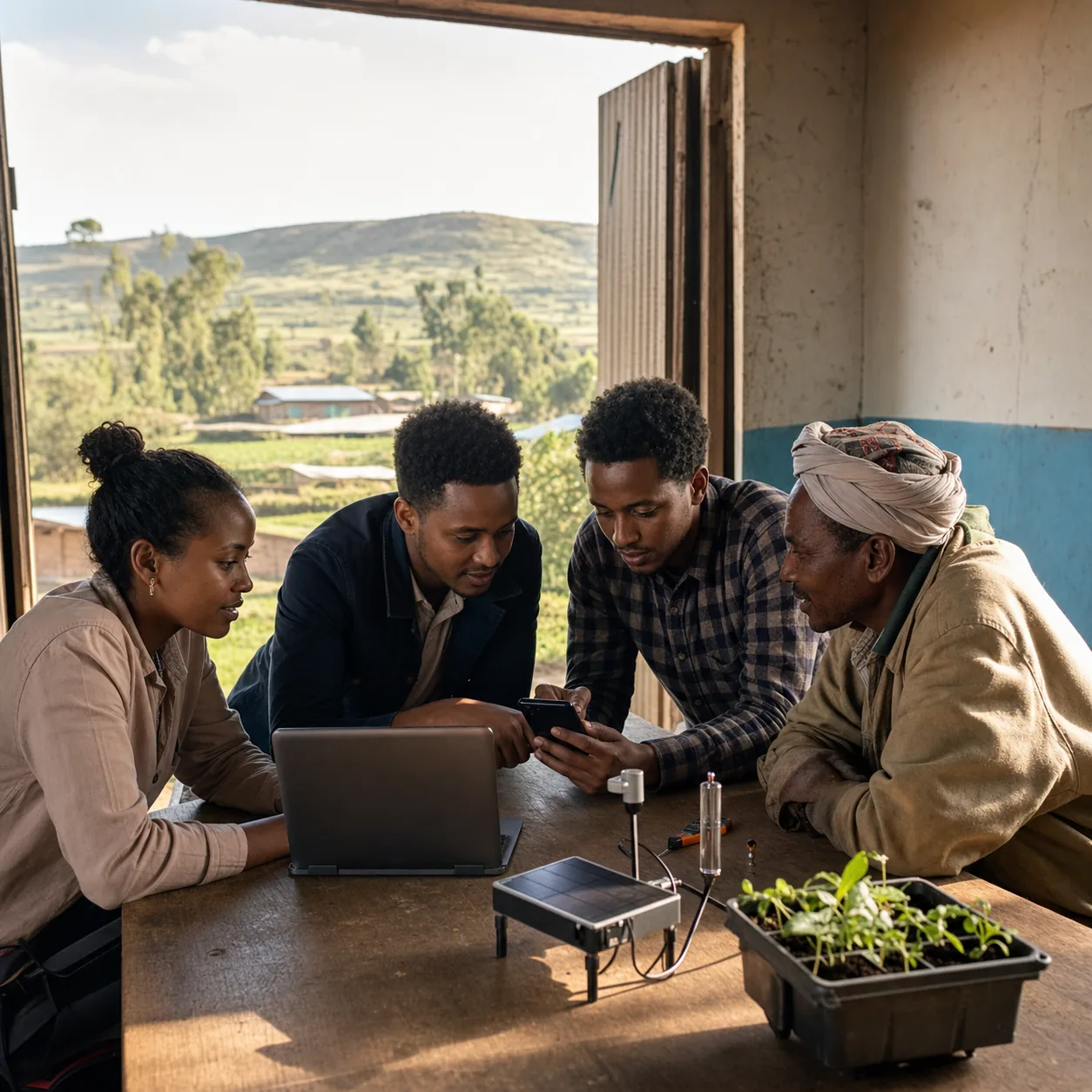
Ethiopia's 2025 and 2030 development plans reveal a deeper startup story: the next wave of growth may come from rural innovation, digital agriculture, local-language products, and inclusive infrastructure.
For years, the standard narrative about African startups has been urban, investor-facing, and a little predictable
It usually begins in the capital city, moves quickly to fintech, and ends with a question about venture capital. Ethiopia's digital development plans suggest a different story. They point not simply to a tech sector in search of investment, but to a country trying to redesign the relationship between technology, geography, and national development itself.
Digital Ethiopia 2030 explicitly frames digital transformation as a tool for inclusive prosperity, national competitiveness, and locally rooted innovation, while also emphasizing that the country's demographic strength lies in a population of more than 130 million, with 70 percent under 30.
That is not just a statistic. It is the outline of a national wager.
The deeper question is what kind of startup culture a country builds
The more interesting question is not whether Ethiopia can produce startups. It already can. The deeper question is what kind of startup culture a country builds when most of its people are still rural, when electricity and internet penetration remain uneven, and when the state sees technology not as a lifestyle layer but as economic infrastructure.
Digital Ethiopia 2030 puts the country's internet penetration at 45 percent, digital economy contribution at roughly 3.9 percent of GDP, and rural population share at 75.8 percent. Those figures reveal both the limitation and the opportunity. Ethiopia's startup future will not be defined mainly by copying Silicon Valley. It will be defined by solving Ethiopian scale problems in Ethiopian conditions.
That is where the story becomes more original than outsiders often realize.
Custom Software Development
Build scalable, secure, and modern software tailored to your specific business needs in Ethiopia.
Participating in state formation through code
In many countries, startup ecosystems mature after infrastructure is already widespread. In Ethiopia, the ecosystem is being asked to grow while infrastructure, regulation, digital public systems, and skills are still being built in parallel. Digital Ethiopia 2030 makes that sequencing explicit. It calls for expanding broadband, building sovereign cloud capacity, increasing AI compute, scaling digital public infrastructure through Fayda ID and interoperable payments, modernizing regulations, and operationalizing the Startup Proclamation with tax incentives, a startup fund, regulatory sandboxes, and new institutions.
This means Ethiopian founders are not entering a finished market. They are participating in state formation through code, services, and platforms.
That distinction matters. It produces a different entrepreneurial culture.
The most consequential startups may not be the most glamorous
The most consequential Ethiopian startups of the next decade may not be the most glamorous. They may be the ones that understand friction. A founder who solves onboarding for semi-formal merchants, crop advisory for smallholders, cross-language service delivery, informal logistics addressing, or trust in low-literacy digital journeys may build a more nationally significant company than one who merely launches another generic marketplace app.
Digital Ethiopia 2025 had already identified agriculture, manufacturing, IT-enabled services, and tourism as the priority digital pathways for prosperity. It also singled out digital agriculture platforms and ag-tech entrepreneurship as strategic opportunities.
Local language as competitive advantage
The startup opportunity in Ethiopia is not merely to build apps for consumers with smartphones in Addis Ababa. It is to translate national bottlenecks into scalable platforms. In a market where digital literacy remains limited, local-language design is not a soft inclusion feature. It is core product strategy.
Digital Ethiopia 2030 explicitly says previous services often lacked cultural and language relevance, and it treats localization as essential to driving engagement. It also calls for all public-facing digital services to support Ethiopia's major languages and for indigenous-language innovation to receive legal protections, incentives, and funding.
In practical terms, this could become one of the country's least-discussed startup advantages: founders who understand Afaan Oromo, Amharic, Tigrinya, Somali, and other local linguistic contexts will be building in terrain where imported products tend to fail.
That kind of advantage rarely shows up in pitch decks, but it determines adoption.
Mobile App Development
We build high-performance iOS and Android apps that your customers will love using.
Artificial intelligence may sharpen this opportunity
Globally, AI is often discussed as a replacement technology. In Ethiopia, the more immediate role may be translation, assistance, verification, routing, and decision support. Digital Ethiopia 2030 places AI at the center of its Industry 5.0 agenda, alongside IoT, cloud, blockchain, XR, robotics, and edge computing.
That means Ethiopian AI companies may emerge not first as frontier-model builders, but as practical systems companies: firms that fine-tune, adapt, localize, and operationalize intelligence in sectors where information is fragmented and decisions are costly.
Institutional trust as the invisible infrastructure
Digital Ethiopia 2030 gives unusual prominence to data governance, privacy, cybersecurity, and digital trust. It calls data a national asset, proposes a National Data Governance Framework and National Data Authority, and envisions a 24/7 cybersecurity operations center.
For startups, these are not bureaucratic details. They are preconditions. Trust determines whether users share information, whether financial services scale, whether AI tools can be deployed responsibly, and whether businesses can integrate with public systems.
In fragile trust environments, growth is not only about speed. It is about legitimacy.
Ethiopia's most transformative startup story may be social before it becomes financial
A country does not become digitally entrepreneurial only by funding a few founders. It becomes entrepreneurial when millions gain enough digital confidence to transact, learn, compare, create, and sell.
This is why the most transformative Ethiopian startup story may end up being social before it becomes financial.
The startup ecosystem that emerges from those ambitions will not be accidental. It will be shaped by the country's development logic, its demographic urgency, its multilingual reality, and its insistence that technology serve national priorities.
That is why Ethiopia's most important startup story may not be about becoming Africa's next copy of somewhere else. It may be about becoming more fully itself.